Showing posts with label early earth. Show all posts

Friday, July 9, 2010

Darwin's pond, revisited


Darwin’s “warm little pond” scenario for the origin of life on earth may not have been hot enough to do the work of chemosynthesis, combining the elements of life—CO2, methane, and water—into more complex biological compounds, and some researchers suggest that hydrothermal vents like those found today in abyssal ocean depths are a more likely candidate for the environment in which life first evolved.

Water gushing from hydrothermal events tends to be alkaline from reaction with minerals in the earth’s crust. When an alkaline hydrothermal fluid (that is, a fluid with low Hydrogen ion levels) mixes with acidic seawater (which has a higher H ion concentration), the resulting pH gradient creates potential energy that can be used to power chemical reactions by the diffusion of hydrogen ions in a process called chemiosmosis.

The oldest and simplest forms of life on Earth may have used chemiosomosis as an energy source.

Source: Nicole Branan writing in Earth, May 2010, based on research by Wm Martin and others in BioEssays

Wednesday, June 30, 2010

Earth's first crust


As Earth cooled from its molten origin, the earliest crust probably consisted of iron and magnesium-rich minerals, minerals that can crystallize at high temperatures. This assemblage of minerals forms the igneous rock basalt.

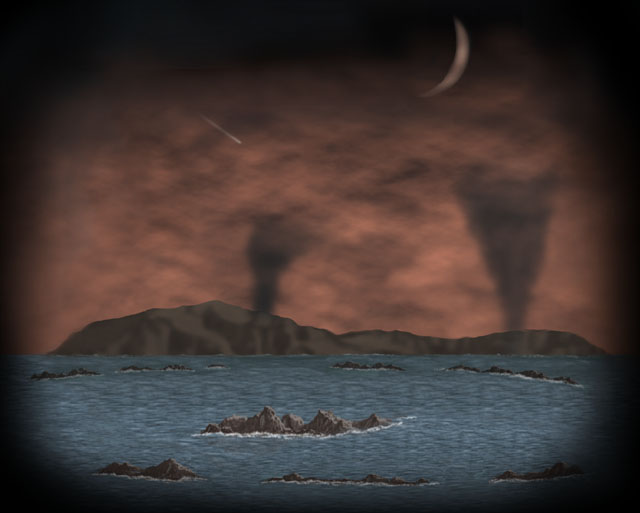
Once the Earth had cooled sufficiently for this initial crust to form, shifting plates of basaltic crust collided, one plate sinking back into the Earth’s mantle, causing the less dense minerals in the upper mantle such as quartz and feldspar, to melt, and forming a lighter, less-dense magma that erupted at the Earth’s surface in a chain of volcanoes, or island arc.

This is the same sort of tectonic activity that formed the Aleutian Islands and the islands of Japan, so we can picture the first landforms on Earth as chains of volcanic islands.

Continents would form later, as tectonic plates carrying these island arcs collided.

Illustration of a very young Earth from here.

More on early Earth from National Geographic.

Monday, June 28, 2010

Catching rays on earliest Earth


The atmosphere of the early Earth was probably lacking in oxygen, as oxygen atoms were likely bonded with hydrogen in water vapor rather than what is called “free oxygen” or 02, so the first lifeforms to appear were probably anaerobes, organisms that can live in the absence of oxygen.

The absence of free oxygen in the early Earth atmosphere also meant that there was no ozone—ozone is a molecule that is formed by linking three oxygen atoms (03), and it is an effective sun block, absorbing ultraviolet radiation from the sun.

In the absence of oxygen and an ozone layer, the first lifeforms must have been extremophiles, living under conditions inhospitable to life. But the fossil record suggests that life took a foothold on Earth just as soon as conditions permitted.

(to be continued)

The illustration shows non-extremophiles protected by the ozone layer of the modern Earth. That site also explains the importance of the ozone layer.

There are many links to sites about the composition of the early Earth atmosphere. Start here.


Friday, June 25, 2010

Taking a breath on earliest Earth


The Earth’s atmosphere probably had its origin in the gasses emitted by volcanoes; Earth was still very hot from its molten, impact-ridden origin, and volcanoes were abundant.

Water vapor is the most abundant component in volcanic gasses today, and this was probably the case in the early Earth as well. Ammonia, methane, and carbon dioxide are also volcanic gasses that were probably important in early Earth atmosphere.

Earth is able to retain its atmosphere because it is sufficiently large to have a gravitational force powerful enough to hang on to it, and because Earth has a magnetic field that protects it from the solar wind that would otherwise strip away the atmosphere.

The effects of not being large enough to hang onto an atmosphere can be seen on the Moon and Mercury.

For more on early Earth's atmosphere, follow this link.

Illustration is from here.

Tuesday, June 1, 2010

"Dark Earth"


Astronomers estimate that the sun was up to 30% dimmer early in its history (before its internal fusion engine was up to full power), and as a consequence put out less heat. Therefore, any water on the young Earth should have been frozen.

However, rocks formed during this period of Earth history, the Archean Eon, about 3.8-2.5 billion years ago, give evidence of deposition in liquid water. This discrepancy has been called the “faint young sun paradox”.

Now there is a new explanation for a warmer-than-expected early earth: Continents were smaller and more of the surface of the Earth was covered by ocean, giving the early Earth a darker, less-reflective surface, or low albedo.

Accordingly, the Earth’s surface absorbed more of the sun’s energy than it would have with a more reflective surface, enough to keep its oceans liquid, and keeping the planet hospitable for the development of early lifeforms.

Source: Rosing, Minik T.; Bird, Dennis K.; Sleep, Norman H.; Bjerrum, Christian J., 2010, No climate paradox under the faint early Sun. Nature 464: 744–747. Also reported in Science News April 24, 2010.

Photo credit and more info on the "faint young sun paradox": http://www.astrosociety.org/pubs/mercury/35_06/paradox.html