Friday, October 15, 2010

Wind energy, revisited


Wind..it’s clean, and does not produce climate-changing greenhouse gasses...

But problems associated with modern wind turbines threaten the growth of wind as an alternative energy source. Birds and bats have been killed by the spinning blades, the motion of the blades can show up on flight controller’s radar, and noise is an issue for people who live near wind turbines.

Twenty years of using modern wind technology has led to some improvements; siting wind turbines now takes into account migratory routes and roosting sites of birds and bats. Engineers are working to make the turbine blades less visible to radar and less noisy.

Ultimately, however, changing negative attitudes toward wind farms must involve more than technological fixes and include public education of the benefits and tradeoffs of wind energy technology.

Source: E. Kintisch, Science 329:788-789

Thursday, October 14, 2010

Nuclear power, revisited


Nuclear energy became anathema after nuclear plant accidents released radioactivity into the environment. But in the wake of environmental accidents due to oil spills and growing concerns about the environmental impact of burning coal, nuclear power is making a comeback.

More than 100 new nuclear power plants are planned to come online, worldwide, over the next 10 years. Lessons learned since Three-Mile Island insure that the new reactors will be safer.

Still a challenge to acceptance and wide-spread use of nuclear power is the disposal of high-level nuclear wastes (HLW), especially the spent fuel rods, which may continue to emit dangerous levels of radiation for a million years. Disposal of HLW is not just a scientific issue but a political hot potato.

Image of the atom from here.

Wednesday, October 13, 2010

National Fossil Day


The record of life on Earth is written in stone--

National Fossil Day is a celebration organized by the National Park Service to promote public awareness and stewardship of fossils, as well as to foster a greater appreciation of their scientific and educational values.
Learn more...


Tuesday, October 12, 2010


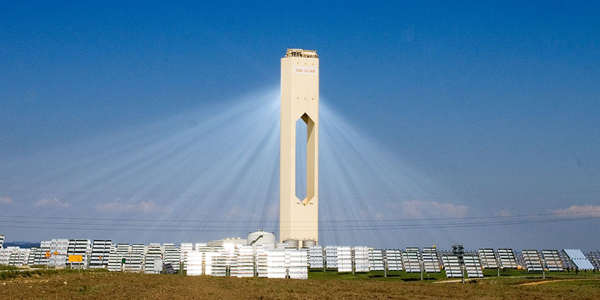
Solar power has matured as an alternative energy source over the last 20 years, but there are still obstacles to overcome before the energy from the sun can significantly supplement other sources of energy.

Collecting solar energy is only part of the process, storing it for later use is still “technically and economically challenging.”* Concentrating solar power plants, or CSPs, like the one shown here, use mirrors to focus solar radiation and generate heat that can be converted to energy, but CSPs are located where the solar radiation is most abundant year-round, which is not where most people and most of the energy demand is.

There are environmental issues, as well. Recently the California Energy Commission recommend against building a new installation in the Mohave desert because of its potential impact on turtles.

*Source: Science, 329:773, August 13, 2010, Roeb, M, and H. Muller-Steinhagen

Photo of concentrated solar power plant, and other information on solar power is available here. This structure's resemblance to Isengard is interesting...

Monday, October 11, 2010

It's Earth Science Week


If you are under the age of 30, you may not be aware that the term “energy crisis” was NOT coined during your lifetime. Your parents might remember the lines at gas stations in the late 1970s.

We find ourselves in the 21st century apparently not having learned the lessons from our earlier crises that stemmed from dependence on a non-renewable energy source—petroleum—the production and transportation of which can have profound environmental effects (two examples: Exxon Valdez and the Deep Horizon oil rig) and the combustion of which contributes to global climate change.

We have learned that our energy choices have profound geopolitical, social, and environmental consequences. The American Geological Institute designates a week in October as Earth Science Week, and this year's theme is energy.

AGI's webpage for Earth Science week is here.


Thursday, October 7, 2010

Flower Power


What would a world without flowers be like?

The dinosaurs knew the answer to that question, as they lived in an age before the evolution of angiosperms, the flowering plants.

Angiosperms are the most diverse group of land plants on Earth today, and include not only all the plants whose blooms we appreciate, like roses, but all our deciduous trees and grasses, and grains--corn, rice, and wheat.

Paleontologists have modeled the flower-less Earth scenario, and found that an Earth without flowers would not only be less colorful, but it would be hotter and drier, as the leaves from angiosperms add a significant amount of water vapor to the atmosphere through the process of transpiration.

Moisture impacts biodiversity as well, and a flower-less Earth would have fewer species of plants and animals. Angiosperms add more than just color to our lives

More information on a world without angiosperms, and a link to the original research here.

Wednesday, October 6, 2010

Melville's Whale


Modern sperm whales, the largest predators alive today, have teeth only on the lower jaw and use suction to catch their cephalopod prey.

The discovery of a new fossil species of sperm whale from rocks 15 million years old helps to fill in our understanding of the evolution of sperm whales. The newly discovered whale has jaws that have both upper and lower teeth, teeth that are 36 cm long, giving this fossil predator the biggest bite known. Based on the size of the skull, paleontologists estimate a body length of 13 to 17 meters.

Named Leviathan melvillei, for the novelist Herman Melville, author of Moby Dick, this sperm whale's appearance in the fossil record coincides with diversification of baleen whales. Leviathan melvillei probably fed on baleen whales and as a top predator, helped shape Miocene marine communities.

See summary of the Nature article and more illustrations here.