Showing posts with label Evolution. Show all posts

Wednesday, May 12, 2010

Before "Jaws"


Ichythosaurs, the dolphin-shaped, marine-dwelling reptiles of the Mesozoic Era, shared the Mesozoic seas with other reptile predators, like mosasaurs and plesiosaurs, but the discovery of a 10-meter long ichthyosaur from 240 million year old rocks in Nevada lays claim to top carnivore in Early Mesozoic marine ecosystems.

The Nevada ichythosaur has serrated teeth, previously unknown in ichythosaurs from this age. Other ichythosaurs of this time had conical teeth fit for grabbing fish and swallowing them whole, or blunt teeth suited for crushing shelly invertebrates like ammonites.

Later ichthyosaurs had serrated teeth, but did not reach the size of the Nevada specimen. This new find indicates that ichythosaurs were ecologically more diverse early in their evolutionary history than previously suspected.

Source: Nadia Frobisch, September 23, 2010, Society of Vertebrate Paleontology meeting.

Illustration from : http://www.marshalls-art.com/images/ipaleo/paleopg17/Ichthyosaurs_final.jpg

Monday, May 10, 2010

A new fossil spider


New fossil finds seem to come out of China on a weekly basis, fostered by international collaborations between Chinese and western scientists. Most famous among the Chinese discoveries are the feathered dinosaurs and rare early mammals, but there are also significant finds of humble invertebrates.

Incredibly well preserved spiders (click on the photo for an enlarged view for details) were discovered in Mongolia from rocks 120 million years old. Even though the fossil spiders are barely 5 mm long, their exceptional preservation permits paleoarachnologists to identify them as members of a modern family of spiders that previous has only been known from the USA, Mexico, Cuba, and Costa Rica.

The discovery extends the geologic range of the family 120 million years to the Middle Jurassic, and indicates that these spiders were much more widely distributed in the past.

Photo and source: Paul Selden and Diying Huang, 2010, The oldest haplogyne spider (Araneae: Plectreuridae), from the Middle Jurassic of China. Naturwissenschaften 97:

See also: Paul Selden and David Penny, 2010. Fossil Spiders. Biological Reviews 85:171-206

Thursday, April 15, 2010

Bridging the gap


The island of Madagascar is separated from Africa by the Mozambique Channel, 460 km across at its narrowest point and up to 3,000 meters deep. Scientists have long debated how the four-legged inhabitants of Madagascar got there, especially the non-aquatic ones.

Seventy years ago paleontologist George Gaylord Simpson proposed a “sweepstakes” model in which small vertebrates could have been transported from the African mainland to Madagascar on natural rafts of floating vegetation.

The problem with Simpson’s idea was that today’s currents flow westward from Madagascar towards Africa. But 60 million years ago continents lay in different positions, and new paleo-oceanographic modeling shows that there was a strong current from Africa to Madagascar, which would have provided the route for the sweepstakes rafts with their accidental migrants onboard.

It took a while, but Simpson's 20th century hypothesis was verified with the help of 21st century technology.

References: http://www.oceandots.com/indian/mozambique-channel/

Ali, Jason R., and Huber, Matthew, 2010. Mammalian biodiversity on Madagascar contolled by ocean currents. Nature 463: February 4

Map is from http://www.embassy.org/madagascar/madagasc.jpg

Wednesday, April 14, 2010

First footprints, revisited


GeoLog has previously reported on the first footprints made on land, tracks in 530-million year old sandstone made by some sort of invertebrate animal, probably an arthropod—a millipede, perhaps. Now comes word of the oldest known footprints of a four-legged vertebrate, or tetrapod, in rocks 395 million years old.

This find is significant because the tracks predate the oldest known tetrapod body fossils by 18 million years, and if these tracks are indeed made by tetrapods, the find would push back the timing of the vertebrate transition from water to land.

In the absence of accompanying body fossils, it is difficult to definitively match trackways with track-makers, and one alternative explanation is that these trackways could have been made by lobe-finned fishes, precursors to the tetrapods.

[One more note: The trackways represent several different animals ranging from an estimated 50 centimeters long to 2 and a half meters long—quite a large animal for so early in tetrapod evolution.]

Sources: Grzegorz NiedΕΊwiedzki, Piotr Szrek, Katarzyna Narkiewicz, Marek Narkiewicz & Per E. Ahlberg Nature 463, 43-48 (7 January 2010) Tetrapod trackways from the early Middle Devonian period of Poland

Perkins, S., 2010, Fossil footprints could push back origin of first four-limbed animals. Science News January 30, 2010.


Monday, April 12, 2010

Battling Beetles


Antlers and horns are usually associated with the male of the species, but sometimes the females bear battle armor.


Female dung beetles have horns that are used in challenging other female dung beetles for dung. Dung beetles lay their eggs in dung, and researchers have found that females with more robust horns produced more offspring than females of similar size but with smaller horns.


Experiments also showed that, unlike males, who may sport extravagant ornament to advertise their superior genetic makeup and suitability as a mate, female ornament does not play a role in sexual selection, at least among dung beetles. So it appears that development of showy weaponry in female dung beetles is related to survival in procuring resources, while in males it functions for survival of a different sort.


Sources: Millus, S., Female beetles ready for dung wars. Science News March 27, 2010

Watson, Nicola and Simmons, Leigh, Proceedings of the royal Society B, March 3, 2010

Watson and Simmons, Behavioral Ecology, March-April, 2010

Photo credit: Sean Stankowski

Friday, April 9, 2010

"Just a theory"


If you want to rile up a scientist, tell them that their understanding of how the world works is “just a theory.”


Remember, in scientific usage a theory is the strongest statement of confidence in explaining the natural world. The most powerful theories tie together apparently unrelated observations.


Evolutionary theory, including the hypothesis of common descent of all living things, is supported by observations as different as paleontological data—the sequence of fossils preserved in the sedimentary rock record; data from biogeography—the modern and fossil distribution of organisms world-wide; data from molecular biology--the close match between human and other primate DNA, data from comparative anatomy—the structural similarities between the skeletal systems of vertebrates from fish to mammals, data from developmental embryology—the discovery of genes common to all vertebrate groups and the role they play in development; among others.


In the sense of having broad support across many different scientific disciplines, evolutionary theory is much more strongly supported than gravitational theory.


Cartoon credit: http://wever.wordpress.com/2008/05/21/

Wednesday, April 7, 2010

Science & Religion: Viva la difference!


Religious belief or faith is an example of a non-scientific way of understanding the universe.


The Apostle Paul defined faith as “being sure of what we hope for and certain of what we do not see” (Hebrews 11:1, New International Version). Faith and religious belief, while essential elements of what makes us human, describe an area outside of scientific inquiry.


The faithful are exhorted to having faith like a rock, unmoving, unchanging, solid; all important qualities in a belief system, but qualities that are counterproductive to scientific inquiry.


Our scientific understanding of the universe—where it came from, how it evolves—continues to change with new observations, new data. Our philosophical understanding of our place in the universe, why we are here, what our purpose is, is the purview of philosophy and religion.


Science and religion are different ways of understanding the universe, both important but occupying separate realms.


Photo credit: http://www.cuttingedge.org/NEWS/earth7.jpg

Tuesday, March 30, 2010

Nature of science, 1


Sixty-six percent of adults in a USA Today/Gallup Poll* responded with “definitely” or “probably true” to the statement that “God created human beings pretty much in their present form at one time within the last 10,000 years”.

Of course, this explanation is not taught in science classes because it is a conclusion that is not based on science but a religious text. The pervasiveness of this erroneous viewpoint points to a fundamental confusion in the minds of many people about what science is and how it works, the areas of human experience that science can and cannot address, and a perceived conflict between the findings of science and personally held beliefs.

So just what is science and what does it do? Continued tomorrow...

*http://www.pollingreport.com/science.htm

photo credit: http://imagecache2.allposters.com/images/pic/MCG/FPF631~Adam-and-Eve-Posters.jpg

Tuesday, February 23, 2010

Charles Darwin & Sexual Selection


Here, in his own words, Darwin’s observations of differences between the sexes that led to his hypothesis of sexual selection:

In the several great classes of the animal kingdom - in mammals, birds, reptiles, fishes, insects, and even crustaceans - the differences between the sexes follow nearly the same rules. The males are almost always the wooers; and they alone are armed with special weapons for fighting with their rivals. They are generally stronger and larger than the females, and are endowed with the requisite qualities of courage and pugnacity. They are ornamented with infinitely diversified appendages, and with the most brilliant or conspicuous colours, often arranged in elegant patterns, whilst the females are unadorned. These various structures for charming or securing the female are often developed in the male during only part of the year, namely the breeding-season.

Photo credit: http://www.crbs.umd.edu/crossingborders/ai2008/lessonplans08.html

Monday, February 22, 2010

Charles Darwin & human evolution


Darwin purposely avoided the subject of human evolution in his book Origin of Species, but 12 years later he met the subject head on in The Descent of Man and selection in relation to sex.

Again, Darwin countered Victorian-era assumptions of special creation with his explanation of descent from a common ancestor and evolution through natural selection.

In this book Darwin introduced the concept of sexual selection, a process that explains some features—like the male peacock’s extravagant tail—as adaptations to ensure reproductive success and the continuation of the species.

150 years later we can see that Darwin did not get everything right in the Descent of Man—like his conclusion that men are more highly evolved than women--but his work brought an intellectual framework to the subject of human origins that paved the way for further research.

Image credit: http://commons.wikimedia.org/wiki/File:Human_evolutionary_tree.jpg

Friday, February 19, 2010

Darwin & Plants


After publishing the Origin of Species, Darwin moved into what might be called his botany phase, and he published 7 books on various aspects of variation in plants. In his autobiography Darwin explained his interest in climbing plants:

I was led to take up this subject by reading a short paper by Asa Gray…. He sent me seeds, and on raising some plants I was so much fascinated and perplexed by the revolving movements of the tendrils and stems, which movements are really very simple, though appearing at first very complex, that I procured various other kinds of Climbing Plants, and studied the whole subject.

Darwin could make sense of this behavior in terms of natural selection. He wrote, some of the adaptations displayed by climbing plants are as beautiful as those by Orchids for ensuring cross-fertilisation.”

Photo credit: http://darwinsflowers.files.wordpress.com/2009/07/10-4-1_darwin_movements.jpg

Thursday, February 18, 2010

Darwin & Orchids


Darwin’s life as a scientist did not end in 1859 with the publication of On the Origin of Species by means of Natural Selection. Three years later he published the results of observations and experiments he had made on orchids, entitled, On the Various Contrivances by Which British and Foreign Orchids Are Fertilised by Insects.

In this book Darwin explained the intimate relationship between orchids and the insects that pollinate them. Darwin described examples of the unique structures that some orchids have that perfectly fit unique structures of the specific insect pollinator for that flower, and he suggested that these complimentary structures existed through a process of co-evolution between the flower and the pollinator as a result of natural selection. Darwin wrote,

I think this little volume will do good to the "Origin", as it will show that I have worked hard at details'.

Photo: Darwin star orchid. Its existence was predicted by Darwin, 40 years before it was discovered.

Wednesday, February 17, 2010

Darwin and Insectivorous plants


Odd plants fascinated Darwin. In his spare time he took up the subject of carnivorous—or more properly, insectivorous, plants.

It was sixteen years from his first observations to publication of his book on Insectivorous Plants, and in his autobiography Darwin put a positive spin on the length of time it took him to publish. He wrote.

"The delay in this case, as with all my other books, has been a great advantage to me; for a man after a long interval can criticise his own work, almost as well as if it were that of another person. The fact that a plant should secrete, when properly excited, a fluid containing an acid and ferment, closely analogous to the digestive fluid of an animal, was certainly a remarkable discovery."

Photo credit: http://darwinsflowers.files.wordpress.com/2009/09/5-3-4_insectivorous_plants_drosera1.jpg

Tuesday, February 16, 2010

Charles Darwin & barnacles


After returning from his Beagle Voyage and before writing Origin of Species, Charles Darwin labored to establish himself as a bona fide scientist. It was all well and good to send reports back from the Beagle and publish an account of his observations during the voyage, but another thing entirely to publish a scientific treatise.

Darwin chose as his subject an animal that he had encountered on the Beagle voyage—barnacles. Most people know barnacles as an encrusting menance on their boats or docks. These strange arthropods live free as larvae, but as adults some settle on a hard surface and form a hard calcite shell around them, others live attached by flexible “stems”.

Darwin spent 8 years laboring over his microscope dissecting the tiny animals. It was all his children knew of his research during that time, and they are reported to have asked their playmates, “where does your father do his barnacles?” Darwin published several monographs on living and fossil barnacles.

Photo credit: http://www.darwininlondon.co.uk/index/darwin-in-london/darwin-and-evolution/

Monday, February 15, 2010

Charles Darwin, Ornithologist


Although Charles Darwin had no formal training in ornithology, the collections of birds he made during his time on the Beagle, breeding experiments he did with his own chickens and pigeons, and observations he made on various habits of birds earn him a place of honor alongside more traditionally trained avian researchers.

Darwin sent back nearly 500 bird specimens from the Beagle voyage, and 38 new bird species were described on the basis of these specimens.

Darwin did not identify the birds himself, but delegated that task to John Gould, the preeminent ornithologist of his day. Even so, the birds that showed variation from island to island in the Galapagos archipelago bear the name “Darwin’s finches” in honor of the man who collected them and explained the significance of their inter-island variation as a manifestation of natural selection.

Tuesday, February 9, 2010

Beetle mania


Charles Darwin’s interest in natural history goes back at least to his days as a college student, although not as an area of study but as an avid hobby.


While a student at Cambridge Darwin took up the Victorian mania for collecting beetles. One day he had collected two beetles, one in each hand, when he spied a third new kind, and in his words, “I popped the one which I held in my right hand into my mouth. Alas! It ejected some intensely acrid fluid, which burnt my tongue so that I was forced to spit the beetle out, which was lost, and was the third one.“


Despite that miscue, Darwin’s beetle-collecting hobby laid his foundation in collecting, identifying and classifying natural history specimens, and taught him something about proper field collecting techniques.


Photo credit: http://www.ent.iastate.edu/imagegal/coleoptera/dogbane/dogbane_beetle.html

Friday, February 5, 2010

Darwin & the Beagle


The seminal event in Charles Darwin’s life was his 5-year voyage around the world on the HMS Beagle.

Darwin kept extensive notebooks of his observations on the plants, animals, fossils, and rocks of the areas he visited.. Darwin’s voyage is most widely remembered for the visit to the Galapagos Islands off the coast of Ecuador, and for the unique animals that inhabited each island, like the marine iguanas, huge tortoises, and birds, but during the voyage Darwin also made the first geological maps of parts of South America, discovered fossils of previously unknown species of extinct South American mammals, and figured out how coral atolls formed.

Darwin returned to England with observations enough to occupy his thoughts for the rest of his long life.

Photo credit: http://theora.com/images/HMS%20Beagle.jpg

Thursday, February 4, 2010

A blog-sized bio


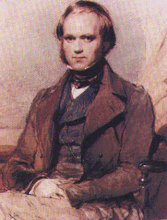
Charles Darwin was born in Shrewsbury, England, February 12,1809, 201 years ago, the son of a wealthy physician.

Across the Atlantic, Abraham Lincoln was born the same day in a log cabin in Kentucky.

Darwin was expected to follow in the footsteps of his father, but, it became clear that he did not have the temperment to witness surgery without anesthetics. His father enrolled him at Christ’s College, Cambridge (1827) to study to become a country parson, but Darwin never became a clergyman.

Darwin had a long-abiding interest in natural history, and one of his early passions was beetle collecting, which was all the rage in Victorian England. As the son of a gentleman and someone with with science training, Darwin was invited to serve as a companion to the captain of the HMS Beagle . He was 22.

The 5-year voyage proved to be the turning point for Darwin, who returned to England with notebooks full of observations occupied his thoughts for the rest of his life.

Wednesday, February 3, 2010

Darwin & God


Because Darwin advocated natural processes for explaining life on Earth, rather than invoking the special creation of every organism by a omniscient being, another widely held misconception about Darwin was that he did not believe in God.

In fact, Darwin was a deeply devout man who studied to be a clergyman at Cambridge, but who also had his faith severely tested by several personal tragedies including the death of three of his children.

Near the end of his life, Darwin described himself as an agnostic—one who concludes that God is "unknowable", that humans cannot prove or disprove the existence of a God. He wrote, ""I cannot pretend to throw the least light on such abstruse problems. The mystery of the beginning of all things is insoluble to us; and I for one must be content to remain an agnostic."

Darwin never lost his sense of wonder at the beauty and intricacy of the natural world and strove to uncover the natural laws that resulted in what he described at the end of his book “Origin of Species” as “endless forms most beautiful"

Photo credit: http://caxton.emich.edu/guide/images/darwin-god.jpg

Tuesday, February 2, 2010

The human-ape thing


Probably the most widely propagated misconception about Darwin is that he said humans evolved from apes.

What Darwin actually wrote was that all life is descended from a common ancestor. This idea makes humans very distant relations to bacterial slime, and closer relations to chimpanzees and gorillas. It means that humans and other primates share a common ancestor and are therefore more closely related to each other than to other groups (like reptiles or fish), not that one group gave rise to the other.

Darwin understood that humans share a common ancestor with apes in the distant geological past, and this conclusion has been verified through modern DNA studies that show chimpanzees to be our closest relations.

Photo credit: www.philadelphia-reflections.com/images/darwin.jpg