Sunday, November 15, 2009

Origin, Chapter 5, Laws of Variation


Darwin recognized that heritable variation in individuals was the key to evolution through natural selection. The “conditions of life” as Darwin called it, were the natural processes that selected which variations would be successfully passed on to the next generation.

Darwin’s ideas about selection have often been misrepresented as invoking chance, and evolution portrayed as a random process. Nothing could be further from the truth. Darwin addresses this in the first paragraph of Chapter 5, stating that viewing variation as due to chance is “wholly incorrect but serves to acknowledge plainly our ignorance of the cause of each particular variation.”

Darwin formed his ideas about natural selection before the discovery of what we now realize is the genetic basis for variation; research in the 150 years since publication of the Origin largely confirm Darwin’s hypotheses.


image: http://www.anselm.edu/homepage/jpitocch/genbio/mitosisnot.html

Monday, November 9, 2009

Origin, Chapter 4, Natural Selection


Darwin devoted this chapter to explaining his ideas about natural selection.

To do this Darwin included a diagram, the only illustration in the original editions of the book. The diagram shows gradually diverging lines representing the offspring of a species becoming more and more distinct through successive generations as natural selection acts on the variation inherent in each individual. Only variations which are in some way profitable to the individual will be preserved or naturally selected, that is, passed on to the next generation.

Through time the gradual accumulation of differences in successive generations results in descendants that are distinct from the ancestral forms. Darwin envisioned this process acting slowly through tens of thousands of generations, and his model for evolution became known as gradualism.

The copy of the diagram shown here is from http://friendsofdarwin.com/docs/origin-1/diagram/

Origin, Chapter 3, The struggle for existence


In this chapter Darwin set out to answer the question of how adaptations arise. His explanation was that adaptations result from what he called the “struggle for existence”. He wrote: “Owing to this struggle for life, any variation, however slight and from whatever cause proceeding, if it be in any degree profitable to an individual of any species, in its infinitely complex relations to other organic beings and to external nature, will tend to the preservation of that individual, and will generally be inherited by its offspring. The offspring, also, will thus have a better chance of surviving, for, of the many individuals of any species which are periodically born, but a small number can survive. I have called this principle, by which each slight variation, if useful, is preserved, by the term of Natural Selection…”

Illustration: The diversity of bird beaks is a prime example of adaptation to different life habits.

Origin, Chapter 2, Variation under Nature


In Chapter 2 Darwin took the principles of selection he described in Chapter 1 for domesticated plants and animals and applied them to the rest of the world, what he termed the natural world. Darwin realized that to describe the variation present in nature and the origin of new species one needs to have a clear understanding of the concept of species and a useful working definition of the word species, and Chapter 2 is devoted to his exposition on the subject. Modern biologists can appreciate the difficulties Darwin recognized in attempting to define species, for even today there is considerable discussion among scientists on what is known as “the species concept”. Darwin’s words from 150 years ago still ring true today when he wrote, “No one definition has as yet satisfied all naturalists…”


A good website for an overview of the species concept can be found at

http://evolution.berkeley.edu/evosite/evo101/VA1BioSpeciesConcept.shtml

Origin, Chapter 1, Variation under domestication


In the first chapter Darwin builds his case for the origin of species by starting with familiar, observable changes brought about by breeding domestic animals. Darwin recognized that the variation inherent in all living things was the key to these changes, and discussed selection as the mechanism of for producing new breeds. Darwin himself took up the popular Victorian hobby of pigeon breeding to test his ideas, and in this chapter he traces the history of pigeon breeding from 3000 B.C., giving credit to Chinese and Romans for recognizing the importance of selection. In summary Darwin wrote, “Over all these causes of Change I am convinced that the accumulative action of Selection, whether applied methodically and more quickly, or unconsciously and more slowly, but more efficiently, is by far the predominant Power.”

Read the Origin online at http://darwin-online.org.uk/EditorialIntroductions/Freeman_OntheOriginofSpecies.html

Sunday, November 8, 2009

On the Origin of Species....Introduction


Darwin uses an introduction to briefly trace the evolution of his thinking on the origin of species and to sum up his main conclusions. The orthodox thinking of Darwin’s time was that species were independently created and immutable, that is, unchanged, since their creation. Darwin challenged this view, which he himself had held until amassing countless observations to the contrary through his travels on the Beagle and experiments he conducted in the years following the voyage. Darwin saw patterns in living things that pointed to common descent and that indicated change or what was then called transmutation of species through time. And he suggested a mechanism for this change, which he called Natural Selection.

Friday, November 6, 2009

150 Years of "On the Origin of Species..."


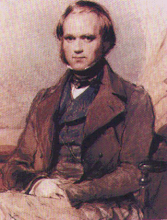
One hundred and fifty years ago, Charles Darwin published The Origin of Species by means of Natural Seletion. In honor of this anniversary, GeoLog Blog will post bite-sized summaries of each chapter from the first edition.

Darwin begins the Origin with a preface, a review of research and thinking on the subject of the origin of species from ancient times to his contemporaries of the mid nineteenth century. Contrary to widespread misunderstanding today, Darwin did not invent the idea of evolution and in this preface he traces the development of ideas about species changes through time from Aristotle to Lamark to his own Grandfather, Erasmus. Throughout the Origin Darwin was scrupulous in giving credit where credit was due and he supported his own observations and conclusions with copious reference to the research of others.

For a link to the Origin, go to:

http://darwin-online.org.uk/EditorialIntroductions/Freeman_OntheOriginofSpecies.html

The Origin was published on November 24, 1859.