Showing posts with label Origin of Species. Show all posts

Monday, February 1, 2010

It's Darwin Month!


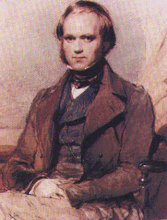
February is Charles Darwin’s birth month, and we will use the occasion to run a series of blogs summarizing the man, his life, and at least some of his contributions to science.

Most folks would probably confess that they know little about Darwin, and odds are that most of what people think they know about him is wrong. For example, one misconception is that Darwin invented the idea of evolution. In his book, On the Origin of species by means of natural selection one of the first things Darwin does is trace the history of thought on change among living things, from Aristotle to his own grandfather.

The word “evolution” does not even appear in Darwin’s writing until later editions of the Origin.

Darwin was not the first person to observe that species evolve, but because of the success of his book--a best-seller in Victorian England--and the robustness of his ideas, he is the best known.


Thursday, December 31, 2009

Origin, Chapter 14: Last words


Darwin saved his most vivid and poetic language for his concluding paragraph. It is also the only place in the entire volume where a form of the word "evolve" is found (the contemporary term to describe the alteration of one species to another was "transmutation"):

It is interesting to contemplate an entangled bank, clothed with many plants of many kinds, with birds singing on the bushes, with various insects flitting about, and with worms crawling through the damp earth, and to reflect that these elaborately constructed forms, so different from each other, and dependent on each other in so complex a manner, have all been produced by laws acting around us…

There is grandeur in this view of life, with its several powers, having been originally breathed into a few forms or into one; and that, whilst this planet has gone cycling on according to the fixed law of gravity, from so simple a beginning endless forms most beautiful and most wonderful have been, and are being, evolved.

Artwork of a "tangled bank" found at http://neurophilosophy.files.wordpress.com/2006/10/tangled.jpg

Wednesday, December 30, 2009

Origin, Chapter 14: Darwin's hope for the future


In his words,

Although I am fully convinced of the truth of the views given in this volume… I by no means expect to convince experienced naturalists whose minds are stocked with a multitude of facts all viewed, during a long course of years, from a point of view directly opposite to mine.

It is so easy to hide our ignorance under such expressions as the “plan of creation” “unity of design” etc. and to think that we give an explanation when we only restate a fact…

A few naturalists, endowed with much flexibility of mind, and who have already begun to doubt on the immutability of species, may be influenced by this volume; but I look with confidence to the future, to young and rising naturalists, who will be able to view both sides of the question with impartiality.

Photo of young naturalists from http://www.fncv.org.au/images/Checking%20for%20pondlife.jpg

Wednesday, December 23, 2009

Origin, Chapter 14: On difficulties with the theory


In his own words:

Such is the sum of the several chief objections and difficulties which may justly be urged against my theory; and I have now briefly recapitulated the answers and explanations which can be given to them.

I have felt these difficulties far too heavily during many years to doubt their weight. But it deserved especial notice that the more important objections related to questions on which we are confessedly ignorant; nor do we know how ignorant we are.

We do not know all the possible transitional gradations between the simplest and the most perfect organs; it cannot be pretended that we know all the varied means of Distribution during the long lapse of years, or that we know how imperfect the Geologic Record is.

Grave as these several difficulties are, in my judgement they do not overthrow the theory of descent with modification.

Geologic timescale from Encyclopedia Britannica; see also http://www.chronos.org/downloads/timetowerparis_highres.png

Tuesday, December 22, 2009

Origin, Chapter 14: Darwin on Biogeography


In his own words:
Turning to geographical distribution, the difficulties encountered on the theory of descent with modification are grave enough.

All the individuals of the same species, and all the species of the same genus, or even higher group, must have descended from common parents; and therefore, in however distant and isolated parts of the world they are now found, they must in the course of successive generations have passed from some one part to the others.

We are often wholly unable even to conjecture how this could have been effected…A broken or interrupted range may often be accounted for by the extinction of the species in the intermediate regions.

It cannot be denied that we are as yet very ignorant of the full extent of the various climatal and geographical changes which have affected the earth during modern periods; and such changes will obviously have greatly facilitated migration.

Photo credit: biogeographic distribution from http://ib.berkeley.edu/labs/mcguire/Sulawesidracos.72.jpg

Monday, December 21, 2009

Origin, Chapter 14: Recapitulation and Conclusion


Darwin's last chapter is probably his most accessible. In his own words:

That many and grave objections may be advanced against the theory of descent with modification through natural selection, I do not deny…

Nothing at first can appear more difficult to believe than that the more complex organs and instincts should have been perfected…by the accumulation of innumerable slight variations, each good for the individual possessor.

Nevertheless, this difficulty, though appearing to our imagination insuperably great, cannot be considered real if we admit the following propositions, namely, --that gradations in the perfection of any organ or instinct…either do now exist or could have existed…-that all organs and instincts are, in ever so slight a degree, variable,-and, lastly, that there is a struggle for existence leading to the preservation of each profitable deviation of structure or instinct.

The truth of these propositions cannot, I think, be disputed.

Shown here: Stages in the evolution of the eye, from http://www.pnas.org/content/104/suppl.1/8567/F1.large.jpg

Friday, December 18, 2009

Origin, Chapter 13, "Mutual affinities of organic beings..."


In the first part of this Chapter Darwin made the case that the Linnean system of classification was in fact based on common descent. He wrote:

From the first dawn of life, all organic beings are found to resemble each other in descending degrees, so that they can be classed in groups under groups … But what is meant by this system? Some authors look at it merely as a scheme for arranging together those living objects which are most alike…many naturalists…believe that it reveals the plan of the Creator; but unless it be specified whether order in time or space, or what else is meant by the plan of the Creator, it seems to me that nothing is thus added to our knowledge…


…I believe this element of descent is the hidden bond of connexion which naturalists have sought under the term of the Natural System.


Photo credit: http://scepticon.files.wordpress.com/2009/02/phylogenetictreeoflife.jpg

Thursday, December 17, 2009

Origin, Chapter 12


This chapter includes observations Darwin made on the Beagle voyage to the Galapagos islands off the coast of South America. The plants and animals of each island bore their own distinctive traits evolved since the organisms had been isolated from other populations, but the country of their common origin was still evident. Darwin wrote:


There are twenty-six land birds, and twenty-five of those are ranked...as distinct species, supposed to have been created here; yet the close affinity of most of these birds to American species in every character, in their habits, gestures, and tones of voice, was manifest. So it is with the other animals, and with nearly all the plants… The naturalist, looking at the inhabitants of these volcanic islands in the Pacific, distant several hundred miles from the continent, yet feels that he is standing on American land.


The birds commonly known as "Darwin's finches" aren't really "his" finches. He collected them, but a prominent ornithologist by the name of John Gould identified them.


Photo credit: http://blog.calgarypubliclibrary.com/blogs/eco_action/darwin%27s%20finches.jpg

Friday, December 11, 2009

Origin, Chapter 11, concluded


Darwin closed this chapter on biogeography with a discussion of how past glacial episodes affected the distribution of plants and animals. This section of the Origin is significant because the fact of past glacial episodes was just being worked out by contemporaries of Darwin. The idea that alpine valley glaciers and vast continental ice sheets once covered portions of the Earth currently not under ice was still gaining acceptance. Much to his credit, Darwin was an early advocate of the new glacial theory.


Glacial theory made sense to Darwin because it helped him to make sense of modern day biogeographic patterns, like alpine plants and animals occupying widely-separated mountain summits. Darwin could explain their dispersal from a common origin, migrating up and down mountain slopes following temperature zones as ice sheets waxed and waned.


Photo credit: http://www.scotland.gov.uk/Resource/Img/47121/0021354.jpg

Wednesday, December 9, 2009

Origin, Chapter 11, continued


In discounting land bridges as a means of species dispersal, Darwin advocated what is called chance or opportunistic dispersal, for example, the seed carried on the waves to a distant island, or a migratory bird blown off course in a storm.


Always the experimentalist, Darwin soaked seeds in salt water to determine how long they could be immersed and still sprout. In one set of experiments he used 87 kinds of seeds, 64 of which germinated after 28 days of immersion; a few survived 137 days—surely time enough for a hypothetical seed to float from a continent to an island. In other experiments he tested the viability of seeds found in the gizzard or crop of birds, and looked for seeds adhering to birds’ feet as two other possible ways to transport seeds. Research since Darwin has borne out the validity of his experiments.


Darwin's last publication, a note published in the British journal Nature on April 6, 1882, (two weeks before his death) was on the chance dispersal of a freshwater clam attached to a beetle's leg. Darwin learned of this specimen from "Mr. W.D. Crick of Northampton"....grandfather of Francis Crick, a co-discoverer of the structure of the DNA molecule 71 years later.


Photo credit: http://www.wsq.org.au/heterotheca_grandiflora40.JPG

Tuesday, December 8, 2009

Chapter 11: Geographical Distribution


In Darwin’s day species were thought to have originated where we find them, so disjunct distributions, that is, similar species found in widely separated areas, were though to have been created separately in both areas.

Darwin maintained that this sort of distribution was more sensibly explained by a single origin flowed by migration, followed by extinction over part of the range, creating the current separated occurrences. He wrote:

“…it seems to me, as it has to many other naturalists, that the view of each species having been produced in one area alone, and having subsequently migrated from that area as far as its powers of migration and subsistence under past and present conditions permitted, is the most probable... the several species of the same genus, though inhabiting the most distant quarters of the world, must originally have proceeded from the same source, as they have descended from the same progenitor.”

Figure: disjunct distribution of the jellyfish Aurelia


Wednesday, December 2, 2009

Origin, Chapter 10, On the geological succession of organic beings


In this chapter Darwin discussed patterns of appearance and disappearance of species in the geological record.

Of extinction, Darwin wrote,

The old notion of all the inhabitants of the earth having been swept away at successive periods by catastrophes is very generally given up. On the contrary, we have every reason to believe that species gradually disappear, one after another, first from one spot, then from another, and finally from the world.”

Darwin’s understanding of extinction followed from natural selection as the active agent, and it countered a Victorian-era notion that species had a definite duration fixed by some unknown natural law. Darwin wrote,

“We need not marvel at extinction; if we must marvel, let it be at our presumption in imagining for a moment that we understand the many complex contingencies on which the existence of each species depends.”


Pictured here: the Tasmanian wolf, Thylacinus cynocephalus. The last known wild Thylacine was killed in 1930; the last captive animal died in 1936.

Tuesday, December 1, 2009

Origin, Chapter 9, part III

Darwin knew he had to address as a potential flaw in his theory the apparently sudden appearance of whole groups of species, which would argue for special creation and against his theory of descent through gradual modification through natural selection. “But”, Darwin wrote,

we continually overrate the perfection of the geological record, …We continually forget how large the world is, compared with the area over which our geological formations have been carefully examined; we forget that groups of species may elsewhere have long existed and have slowly multiplied before the invaded the ancient archipelagos of Europe and of the United States…”

Darwin’s explanations have been largely borne out by paleontological research in the 150 years since publication of the Origin, and the sudden appearance of most groups or organisms is another artifact of an incomplete, and incompletely known, fossil record.

Precursors of the "Cambrian explosion" (an artist's impressionistic interpretation shown here) are now known in the Precambrian. Image of the "Cambrian Explosion" is from http://www.futurehi.net/images/cambrian.jpg

Wednesday, November 25, 2009

Origin, Chapter 9, On the imperfection of the geological record


This is a geologist's favorite chapter because the data (or lack of data?!), that is, fossils and the rocks they are found in, play the starring role; they are the source of the "most obvious and gravest objection which can be urged against my theory" as Darwin wrote, because of the apparent lack of transitional lifeforms predicted by his theory of incremental, gradual change.

Darwin was well aware of this "problem" with his theory and used this chapter to head off anticipated objections.

The apparent lack of transitional forms was not the only problem Darwin addressed in this chapter. Communicating to the general public the immensity of geological time was another challenge. Darwin's scenario of slow, gradual change required vast expanses of time and he advised his readers that if they did not acknowledge "how incomprehensibly vast have been the past periods of time" they should "at once close this volume."

Always the experimentalist, Darwin suggested a line of inquiry/observation one could pursue to illustrate the phenomenon: "A man must for years examine for himself great piles of superimposed strata, and watch the sea at work grinding down old rocks and making fresh sediment, before he can hope to comprehend anything of the lapse of time, the monuments of which we see around us."

Tuesday, November 24, 2009

Happy Origin Anniversary!


As celebrated as Darwin's On the Origin of Species by means of Natural Selection is for its impact on science and society, it almost was not written. Darwin kept his ideas on the trasmutation of species confined to his notebooks and conversations with close friends and colleagues because he was aware of the firestorm of public opinion that would result from the clash of his ideas with prevailing Victorian philosophy of special creation and immutability of species.

It was only after Alfred Russel Wallace wrote Darwin with his own nearly identical views of the origin of species that Darwin’s friends pushed him to publish. Darwin considered the resulting 490-page book only an “abstract” of a larger work to come.

The first printing of the Origin sold out on its publication date, November 24, 1859 .

.

Friday, November 20, 2009

Origin, Chapter 7, Instinct


In this chapter Darwin continues his preemptive explanations and justifications for natural selection in relation to anticipated criticisms, this time of the criticism that instinct—a form of behavior—would not be amenable to natural selection. Not so, said Darwin.

Darwin wrote, “It will be universally admitted that instincts are as important as corporeal structure for the welfare of each species, under its present conditions of life. Under changed conditions of life, it is at least possible that slight modifications of instinct might be profitable to a species; and if it can be shown that instincts do vary ever so little, then I can see no difficulty in natural selection preserving and continually accumulating variations of instinct to any extent that may be profitable. It is thus, as I believe, that all the most complex and wonderful instincts have originated.

He argued that instincts are subject to natural selection and are as important as the “corporeal structure” of the organism, and as such was subject to natural selection.

As usual, Darwin supported his arguments with a catalog of examples of instinctive behavior from cats to dogs to birds to the hive-making of bees to demonstrate
variation in instinctual behaviors present in modern groups, variation that would be available for natural selection to act upon.

Darwin ended this chapter with some of the nastier instincts in the animal kingdom, like juvenile cuckoos ejecting siblings from the nest, and concludes that
‘it is far more satisfying “ to look at these unappetizing behaviors not as specially endowed or created instincts, but as small consequences of the general law, leading to the
advancement of all organic beings, namely, multiply, vary, let the strongest live and the weakest die.

Origin, Chapter 6, continued


Another difficulty Darwin faced in advocating a theory of species origin by descent from a common ancestor was the Victorian era mind-set that species were specially created and immutable or unchanging and without transitions between forms.

To support his ideas Darwin pointed to living animals that show a range of modifications of a shared structure. Using birds as an example, Darwin described the diverse development of the wing, from fully functional for flight in air, to their use as fins in an aquatic habitat, as with penguins, to functionally of no use, like the wings of the flightless kiwi.

These examples served to show the range of transitions present within a living group of animals and laid the groundwork for thinking about the cumulative effect of variations as natural selection acted over the immensity of geologic time.

Image from http://farm4.static.flickr.com/3272/2592965662_0bef2d19e2.jpg?v=0

Thursday, November 19, 2009

Origin, Chapter 6, a whale of a difficulty


Darwin wrote, “It has been asked by the opponents of such views as I hold, how, for instance, a land carnivorous animal could have been converted into one with aquatic habits; for how could the animal in its transitional state have subsisted?”

To address this Darwin cited examples of modern animals that posses transitional habits, like mink, which are at home on land and in water, and examples of animals with present adaptations that are ill suited to their present habitat, like upland geese that rarely or never go near the water, yet have webbed feet.

Again, 150 years of research has borne out Darwin’s hypotheses, and the evolution of the whale is the prime example of a land carnivorous animal that converted to an aquatic habit.

Image of whale evolution from http://darwiniana.org/whale1.gif

Wednesday, November 18, 2009

Origin, Chapter 6, yet more difficulties


Darwin anticipated by 150 years arguments that modern day advocates of intelligent design would make that “organs of extreme perfection and complication”, like the eye, could not have been made through natural selection, but must have been specially created. Actually, the idea of intelligent design is not new, but goes back at least to British Philosopher William Paley’s 1802 book entitled Natural Philosophy, with which Darwin was familiar. In the Origin, Darwin presents a scenario for the evolution of the eye, from a light-sensitive nerve imparting some advantage to the animal, through intermediate stages gradually to a more complex light sensitive organ. Since publication of the Origin, research on the evolution of the eye has in fact filled in details of this transition, confirming Darwin’s hypothesis.

Monday, November 16, 2009

Origin, Chapter 6, Difficulties on Theory


This chapter is a preemptive strike against anticipated criticisms of Darwin’s ideas.

One obvious potential flaw in Darwin’s theory of common descent was the apparent lack of transitional forms linking different groups in the fossil record. Darwin himself asked, “Firstly, why, if species have descended from other species by insensibly fine gradations, do we not everywhere see innumerable transitional forms?” Darwin’s response to this question was to invoke the imperfection of the geological record, the fact that fossilization is the exception rather than the rule. Darwin wrote, “The crust of the earth is a vast museum, and the natural collections have been made only at intervals of time immensely remote.”

Darwin’s theory of gradual change made the prediction that transitional forms should exist, and this prediction has been borne out many times in the 150 years since publication of the “Origin” by new fossil discoveries.

Image: Archaeopteryx, whose discovery just after publication of the Origin lent support to Darwin's theory.