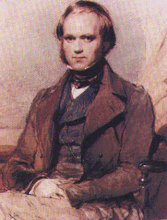
Wednesday, February 10, 2010

Charles Darwin, Geologist


Although more widely remembered for his contributions to the biological sciences, Charles Darwin first made his scientific reputation as a geologist.

His formal geological training was limited, but intense; he accompanied the eminent geologist Adam Sedgwick "geologising", that is,describing and mapping the rocks of Wales and learning the ways of the field geologist.

A few months later Darwin was on board the Beagle, with a volume of Charles Lyell’s new book, Principles of Geology. Lyell was the foremost geologist of the day. With this as his guide, Darwin made observations during the voyage that led to publications on the formation of coral reefs and volcanic islands and the geology of South America, contributions that still stand, today.

Photo: Rocks collected by Charles Darwin during his voyage on the Beagle. credit: http://www.flickr.com/photos/gruts/3802735409/

Tuesday, February 9, 2010

Beetle mania


Charles Darwin’s interest in natural history goes back at least to his days as a college student, although not as an area of study but as an avid hobby.


While a student at Cambridge Darwin took up the Victorian mania for collecting beetles. One day he had collected two beetles, one in each hand, when he spied a third new kind, and in his words, “I popped the one which I held in my right hand into my mouth. Alas! It ejected some intensely acrid fluid, which burnt my tongue so that I was forced to spit the beetle out, which was lost, and was the third one.“


Despite that miscue, Darwin’s beetle-collecting hobby laid his foundation in collecting, identifying and classifying natural history specimens, and taught him something about proper field collecting techniques.


Photo credit: http://www.ent.iastate.edu/imagegal/coleoptera/dogbane/dogbane_beetle.html

Friday, February 5, 2010

Darwin & the Beagle


The seminal event in Charles Darwin’s life was his 5-year voyage around the world on the HMS Beagle.

Darwin kept extensive notebooks of his observations on the plants, animals, fossils, and rocks of the areas he visited.. Darwin’s voyage is most widely remembered for the visit to the Galapagos Islands off the coast of Ecuador, and for the unique animals that inhabited each island, like the marine iguanas, huge tortoises, and birds, but during the voyage Darwin also made the first geological maps of parts of South America, discovered fossils of previously unknown species of extinct South American mammals, and figured out how coral atolls formed.

Darwin returned to England with observations enough to occupy his thoughts for the rest of his long life.

Photo credit: http://theora.com/images/HMS%20Beagle.jpg

Thursday, February 4, 2010

A blog-sized bio


Charles Darwin was born in Shrewsbury, England, February 12,1809, 201 years ago, the son of a wealthy physician.

Across the Atlantic, Abraham Lincoln was born the same day in a log cabin in Kentucky.

Darwin was expected to follow in the footsteps of his father, but, it became clear that he did not have the temperment to witness surgery without anesthetics. His father enrolled him at Christ’s College, Cambridge (1827) to study to become a country parson, but Darwin never became a clergyman.

Darwin had a long-abiding interest in natural history, and one of his early passions was beetle collecting, which was all the rage in Victorian England. As the son of a gentleman and someone with with science training, Darwin was invited to serve as a companion to the captain of the HMS Beagle . He was 22.

The 5-year voyage proved to be the turning point for Darwin, who returned to England with notebooks full of observations occupied his thoughts for the rest of his life.

Wednesday, February 3, 2010

Darwin & God


Because Darwin advocated natural processes for explaining life on Earth, rather than invoking the special creation of every organism by a omniscient being, another widely held misconception about Darwin was that he did not believe in God.

In fact, Darwin was a deeply devout man who studied to be a clergyman at Cambridge, but who also had his faith severely tested by several personal tragedies including the death of three of his children.

Near the end of his life, Darwin described himself as an agnostic—one who concludes that God is "unknowable", that humans cannot prove or disprove the existence of a God. He wrote, ""I cannot pretend to throw the least light on such abstruse problems. The mystery of the beginning of all things is insoluble to us; and I for one must be content to remain an agnostic."

Darwin never lost his sense of wonder at the beauty and intricacy of the natural world and strove to uncover the natural laws that resulted in what he described at the end of his book “Origin of Species” as “endless forms most beautiful"

Photo credit: http://caxton.emich.edu/guide/images/darwin-god.jpg

Tuesday, February 2, 2010

The human-ape thing


Probably the most widely propagated misconception about Darwin is that he said humans evolved from apes.

What Darwin actually wrote was that all life is descended from a common ancestor. This idea makes humans very distant relations to bacterial slime, and closer relations to chimpanzees and gorillas. It means that humans and other primates share a common ancestor and are therefore more closely related to each other than to other groups (like reptiles or fish), not that one group gave rise to the other.

Darwin understood that humans share a common ancestor with apes in the distant geological past, and this conclusion has been verified through modern DNA studies that show chimpanzees to be our closest relations.

Photo credit: www.philadelphia-reflections.com/images/darwin.jpg

Monday, February 1, 2010

It's Darwin Month!


February is Charles Darwin’s birth month, and we will use the occasion to run a series of blogs summarizing the man, his life, and at least some of his contributions to science.

Most folks would probably confess that they know little about Darwin, and odds are that most of what people think they know about him is wrong. For example, one misconception is that Darwin invented the idea of evolution. In his book, On the Origin of species by means of natural selection one of the first things Darwin does is trace the history of thought on change among living things, from Aristotle to his own grandfather.

The word “evolution” does not even appear in Darwin’s writing until later editions of the Origin.

Darwin was not the first person to observe that species evolve, but because of the success of his book--a best-seller in Victorian England--and the robustness of his ideas, he is the best known.